Friday, September 6, 2013

#38 - Onawe Mature Cheddar from Barry's Bay

Whilst I was on my trip around the upper South Island in July, I visited the  Barry's Bay cheese factory, nestled beside the water on the Banks Peninsula. Apart from the beautiful location, they make some good cheese.  I was able to try (or take away to try later) most of the Barry's Bay cheeses, and was even lucky enough to be shown through the factory by friendly factory manager Andrew.  It was good to see the traditional open cheese vats and cheese making equipment still being used in the way Cheddar used to be made all over New Zealand.  And even a vintage boiler is lovingly maintained to keep the hot water and steam supply running.

Barry's Bay and the Akaroa Harbour

But anyway, to the cheese.  One of the better cheeses tasted was the Onawe mature Cheddar.  This cheese is made in January and February (the middle of the milking season) when the milk is at it's best and most consistent.  The recipe is the same as the cloth bound Cheddar also made at Barry's Bay, although the Onawe is then ripened as 20kg blocks in vacuum sealed plastic bags like most other Cheddar made in New Zealand.  After two years of maturing, the blocks are tasted and cut for retail packaging.

The cheese had a good waxy Cheddar texture, and there were a few small crystals in it - in keeping with its age and flavour development.  The sample was a little bitter for our liking, however it was an improvement over the Extra Tasty Cheddar also tried at the same time.  There was also a slight sweetness and a background savoury/vegetable flavour.  In comparison to the Extra Tasty, the Onawe had more flavour overall and was creamier.  Apart from the bitterness, which many people may not pick up (admittedly my wife is very sensitive to it, and we are used to "looking" for it when we evaluate or judge cheeses) the Onawe was pretty well balanced and most people would find it to be a delicious cheese.  I'm sure it would get demolished pretty quickly as part of a cheeseboard with some chutney or savoury jam.
Onawe Mature Cheddar.  Disclaimer - the scruffy appearance and packaging are not characteristic of Barry's' Bay products, this was an off-cut sample given to me for tasting. 
 

Friday, August 16, 2013

#37 - Whitestone Windsor Blue

I love blue cheeses.  So when I was at Canterbury Cheesemongers on my recent South Island road trip, I purchased some Windsor Blue to add to my picnic lunch supplies.

I won't write much about Whitestone cheese, as there is plenty of information available on their website (www.whitestonecheese.com), and many people are familiar with their brand, being one of the largest artisan cheese producers in New Zealand.  Their Windsor Blue has won countless medals at the NZ Champions of Cheese Awards over the years - including Supreme Champion in 2006.  So it has a strong pedigree.

Unfortunately the sample I had purchased was probably not up to the high award winning standard usually expected, but it was still a nice cheese. The appearance was good, a nice rind and good blue veins throughout the paste.  It had a very creamy texture in my mouth.  There were parts of the cheese that had not ripened that much - these had a bitterness at first and a very slight petroleum taste.  To be fair though, many people may not even notice these slight flavours - they are something I pick up from regular tasting and judging of cheeses.  These would probably disappear as the cheese matured more and developed stronger flavours from more proteolysis and lipolysis.  Other parts of the cheese with more blueing had a nice earthy stronger flavour.  Personally I would have preferred some more age on the cheese - but then I do love a really strong blue, which is not to everyone's taste.
When considering the individual sample I tasted, we should remember the variability that must be expected with artisan cheeses.  The same cheese can vary from batch to batch, round to round, and even within a cheese itself.  So a cheese selected from a good batch is not guaranteed to be as stunning as others in that batch.  This is no reflection on the cheese maker or cheesemonger.    We should be more concerned about the quality and consistency of the cheese over time rather than small variations between batches.  And Windsor Blue certainly has shown to be consistently good.  And I would certainly prefer to buy my cheese cut fresh from a round at a good cheese shop, rather than sealed in plastic at the supermarket.
Windsor Blue - I've already cut the best part off for my lunch!

Windsor Blue went well in my road trip picnic at Hanmer Springs.

Friday, August 2, 2013

Book review - Cheese: The World's Best Artisan Cheeses by Patricia Michelson

Instead of writing about a particular cheese this week, I thought I'd mention a great book which I have carried around the world.  I am talking about "Cheese: The World's Best Artisan Cheeses, a journey through taste, tradition and terroir", by Patricia Michelson.


Patricia runs the famous La Fromagerie in Marylebone, London, which I wrote about last year (read it here).  My mother gave us Patricia's book for Christmas in 2011 not long before we left New Zealand on our trip around the world, and we took it with us on our travels, adding notes on the cheeses we tasted.  Mostly this was in the UK and on the West Coast of the USA - we felt we had made notes on lots of cheeses, but when we look at all the ones in the book we haven't tasted, we realise we have many more trips to come in the future!  Sadly when we visited La Fromagerie in London, we were not able to meet Patricia and show her our well-travelled book, but we did marvel at the number of cheeses in the famous cheese room.

The book is broken down into regions of the world - The British Isles & Ireland; France; Alpine Europe; Italy; Spain & Portugal; The Rest of Europe; USA & Canada; Australia & New Zealand.  Then within each zone the cheeses are broken down further into sub-regions.  The book isn't a comprehensive list of all cheeses in the world (there are many less-well known cheeses and regions not covered at all), but that would be almost impossible.  Instead, each cheese is presented with a few paragraphs (and sometimes a full page) of background information about the cheese makers, the farm, its history, the manufacturing process, or a description of how it is often eaten.  This is done in an informative and neutral way, rather than telling the reader what they should and shouldn't like.  Patricia never comes across as judgmental or more important than the cheese makers.  And the photos in this book are really good - they show the cheeses beautifully and there is a photo for almost every cheese described.

At the back of the book there are also some recipes and useful tips for serving and caring for cheese, but I personally don't focus on these because the main part of the book is such good reference material.  Sometimes I find myself just flicking through the book, looking at cheeses and imagining a new trip to visit a particular region.

All in all, I would recommend this book for anyone that is passionate about cheese.  Use it either as a coffee table book or as a reference book or even a journey planner!  We certainly found it useful on our trip around California and Oregon, helping us pick out a few locations to detour to along the way.  My only disappointment is the small size of the section on New Zealand cheeses.  I'm sure there are more cheeses in this country worthy of the world's attention - but then I am biased.  I shall have to work on this!
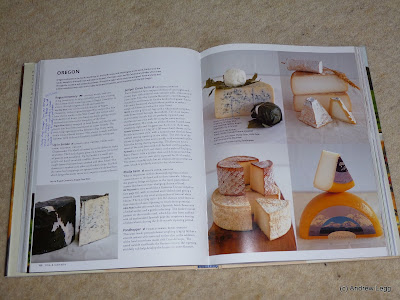
The book has travelled well with us - showing here some notes from our brief time in Oregon.

Friday, July 26, 2013

#36 - Mainland Noble Tasty Cheddar

Ok, I have to declare a personal bias for this cheese, as I was one of the technologists involved in developing it when I worked at the Fonterra Research Centre.  But it really is a good cheese - even with my independent hat on, given I no longer work for Fonterra.  It is good to see that all the hard work put in over the years by many researchers has been launched onto the market.

The key thing about Noble Tasty Cheddar is that it has 30% less fat than standard Cheddar cheese - but it still tastes great (if not better than any other supermarket cheeses out there).  Many reduced fat cheeses can be lacking in flavour, and in particular reduced fat cheddars are often rubbery or bitter. Using a combination of well controlled manufacturing conditions, a selection of cultures, and some care, it is possible to actually make this cheese that develops a great flavour and texture as it matures.
The Noble Cheddar in the supermarkets at the moment appears to be at the younger end of the scale, so it has a young cheddary texture, but it has a good amount of flavour with some extra savoury notes not seen in standard Tasty.  From my experience, I know that the flavour of this cheese ages well - as it matures it will develop some strong savoury and slightly fruity notes.  I would expect a good piece of this Noble Cheddar at 12 months old to have stronger and more interesting flavours than a regular Tasty.

As the Noble Cheddar ages, it will develop small crystals both inside the block and on the cut surfaces.  These are a a mix of minerals and amino acids formed as a result of the aging processes going on in the cheese itself, and are perfectly normal.  Some people wait until the cheese is riddled with crystals before they even eat it as they know the flavour will be super strong.  However on the flip side, if you prefer a milder cheese, pick a younger one with less crystals.

A testimony to this cheese is that during its development, it won a gold medal at the 2011 International Cheese Awards in Nantwich, England.

OK, so it's not a gourmet artisan cheese, and I have a personal bias for it, but as far as commercial cheeses from big suppliers go, this is a very good cheese, even before you consider it is 30% reduced in fat!

Friday, July 19, 2013

# 35 - Karikaas Vintage Leydon (cumin seed gouda)

New Zealand has fantastic Gouda cheeses, made by Dutch families who have immigrated over the last few generations and kept up the traditional cheese making methods.  One could even argue that the best Dutch cheeses are found in New Zealand!

On my way North from Christchurch to Nelson, I took a small detour inland through Rangiora to stop in at the Karikaas factory and shop at Loburn.  Karikaas was started in 1984 by Dutch immigrants Karin and Rients Rypma, and makes Dutch-style cheeses and fresh European style dairy products.  Since the late 1980s, the milk they use has been sourced from a single local farm.

One of the cheeses Karikaas is best known for is their Vintage Leydon - a traditional Gouda with cumin seeds added.  The balance between the cumin flavour and the cheese itself changes as the cheese ages.  The younger cheeses are delicious but perhaps the cumin seems stronger compared to the cheese flavour.  By the time the cheese has aged for a couple of years, I think it reaches the best balance between the rich, savoury flavours of the cheese and the cumin seeds.

So I bought a piece of Vintage Leydon - cut from the wheel - to take on my trip North.  I found a nice calm spot for lunch on the beach at Rabbit Island, near Nelson.  The piece of cheese I had was delicious - it would have been a good vintage Gouda in its own right - slightly sweet, firm but not crumbly, savoury with a slight nuttiness, and clean acid dryness when first put in the mouth.  But the cumin adds an extra dimension - it was not dominant but balanced perfectly with the other flavours of the mature cheese.  This would not have been the case with a 'base' cheese of lesser quality.  This went well with the Danish Salami in my 'road trip wrap' - although next time I'll opt for a salami with less garlic so I can taste the other cheese!


Friday, July 12, 2013

South Island cheese tour

I am just coming to the end of a week long cheese tour of the upper part of the South Island. I have driven myself over 1400 km from Kaikoura down to Christchurch, Rangiora, and up to Nelson, during which I have visited cheese shops, artisan cheese makers and markets.  I have met so many cool, friendly, open and passionate people and I am looking forward to writing posts about my trip.  So keep an eye on the blog in the coming weeks and months for some great Kiwi cheeses and brands you may not have heard of.

Friday, June 14, 2013

#34 - Kallarney Blue by The Cheese Barn at Matatoki

Back in March my mother went on a trip to the Coromandel peninsula, and on the way she stopped off at The Cheese Barn at Matatoki.  One benefit of being involved in the cheese industry is that every time anyone in our families stops at a cheese shop they inevitably purchase something to bring back for us to try out!

So mum had purchased a wedge of Kallarney Blue for us.  This cheese was made from organic cow's milk, and using vegetarian rennet.  The fat content was stated as 29.5%, which I calculate to give a cheese of around 50% FDM (for those Europeans used to such terminology).

The wedge of cheese was wrapped in cling film and it had obviously been wrapped up for a while as the surfaces did not look very fresh, and were a little dry and oxidised.  This is not something to worry too much about, as simply scraping down the surfaces with the face of a knife will tidy it up well.

The cheese paste was firm, slightly dry, almost like a soft, slightly crumbly cheddar. It had nice blue marbling throughout.  The flavour was quite savoury - almost meaty - and there was good balance between this savouriness, the blue veins and the salt.

Overall a nice cheese.  Given that our sample didn't appear so fresh, we would recommend looking for a piece that had been more recently cut from the truckle.  Kallarney Blue would go well in a cheeseboard selection with some nice chutney or a savoury crab-apple jelly.    

Kallarney Blue from The Cheese Barn at Matatoki.